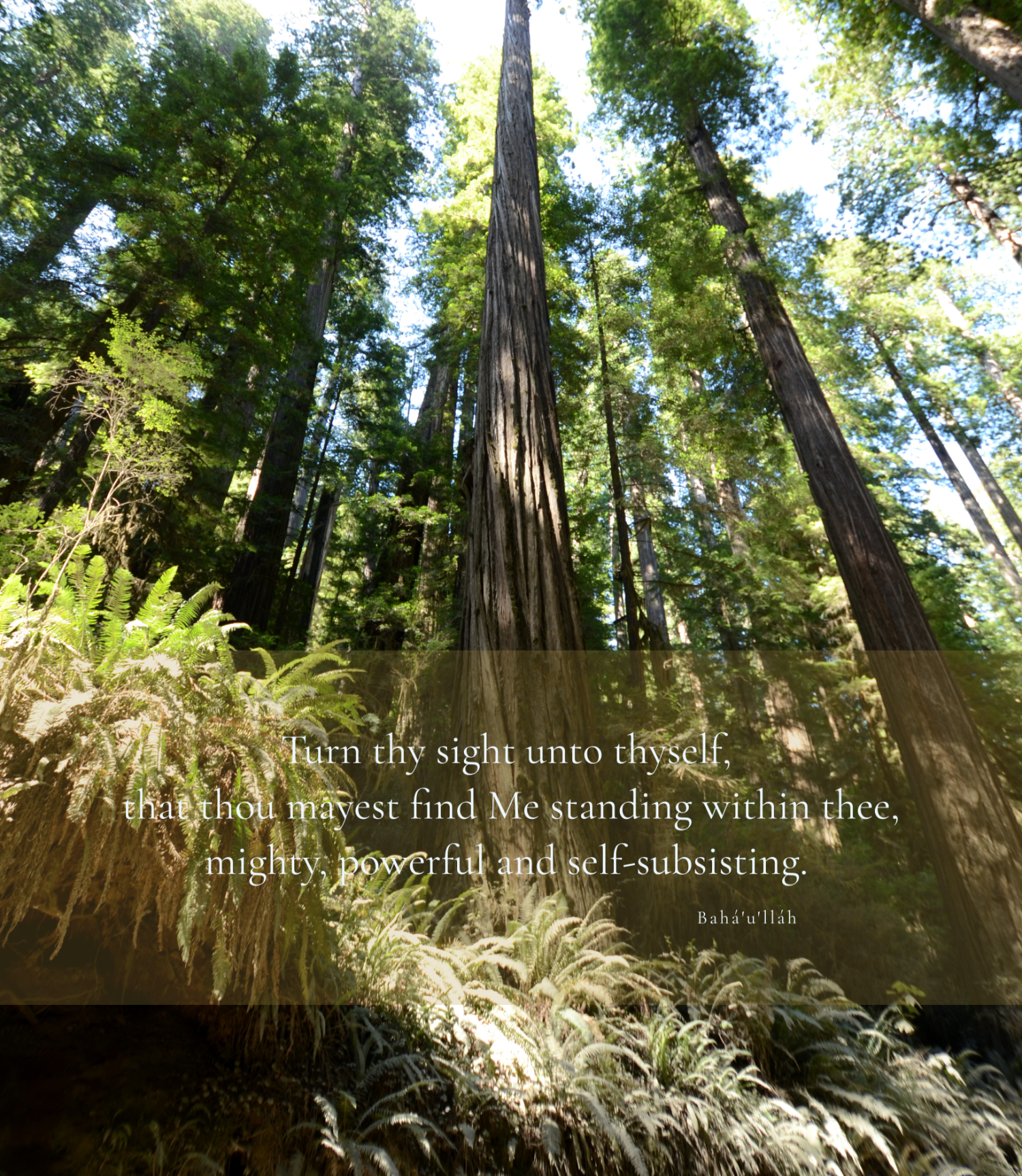

The grove was quiet in the way only ancient places can be, the kind of stillness that seems to listen back. Everything moved slowly here—the air, the dappled light, even my own breath. I placed my hand on one of their trunks, warm and fibrous and impossibly old, and felt small in a way that did not diminish me, but somehow gathered me in, cradling me as one of their own. Standing among these giants, I sensed how each tree's stability drew from the stability of the others. A single Sequoia cannot hold itself against a storm. But a grove of Sequoias, rooted in shared ground—hanging, in a sense, from the same vast network below—can withstand centuries.
We often speak of balance, of the need to keep our lives in balance, to find balance amid the demands placed upon us. Yet balance, by its very nature, is a scale. And a scale, for all its usefulness, is a remarkably simple instrument. Invented thousands of years ago, in the ancient marketplaces of Egypt and Mesopotamia, the scale was used for a simple task: to weigh one thing against another, to bring two opposing quantities into agreement so that a transaction could be settled. To seek balance presupposes a world of two sides, and only two sides. It assumes that what is being measured can be reduced to weight—the weight of a precious stone, of a tired child in your arms, of a promise long kept, of lived wisdom and ambitious dreams.
But we are not made of two sides. We are not a transaction between work and rest, self and other, giving and receiving. We are not a sum to be balanced. We are something far more intricate, far more complete. Our lives are braided by many strands at once: relationships, callings, longings, responsibilities, seasons of grief and seasons of bloom, the quiet inner life and the active outer one, the body and the spirit, the past we carry and the future we reach toward. To place all of this on a scale is to ask an ancient tool to do something it was never intended to do.
A scale, by its very design, only “works” within a framework of opposition. When we apply this logic to our lives, we begin, often without noticing, to compare our lives to others and to see the various parts of ourselves as adversaries. Work becomes the opposite of rest. Service becomes the opposite of self-care. Ambition becomes the opposite of presence. Each piece of who we are is set against another piece, and we are left as the weary arbiter, trying to keep the scales from tipping. The exhaustion many of us feel in the name of "finding balance" is not a failure of effort. It is the natural consequence of asking the wrong tool to hold the wholeness of a life.
So, what if what we are truly seeking is not balance, but something else entirely?
Consider, instead, a mobile. Unlike a scale, the mobile is a recent invention, a product of the modern imagination. Where the scale was conceived in the ancient world for the marketplace, designed to measure value and settle a transaction, the mobile was conceived in the twentieth century as a work of art. It was born not of commerce but of wonder, not to weigh but to move, not to resolve into stillness but to dance with the breeze. From its very origin, the mobile assumes something the scale never could: that reality is complex, full of various elements living in relationship with one another.
Working by suspension rather than opposition, a mobile gathers many pieces around a shared center. Each one is held, not against another, but alongside, in its own true place. The arrangement honors the actual weight of each element, rather than demanding that everything be the same. And when something shifts, as something always does, the mobile responds with grace. The whole structure adjusts, not by trading one piece for another, but by gently reorganizing around the same quiet center. Nothing falls. Nothing fights. The pieces are not in competition; they are in conversation. And this conversation is not balance. It is coherence.
Bahá'u'lláh tells us:
In all matters moderation is desirable. If a thing is carried to excess, it will prove a source of evil.
Notice the call: moderation in all matters, which must—if taken seriously—include moderation itself. Here the scale reveals a paradox. How can one moderate moderation without tipping the very thing meant to hold steady? With a mobile, the paradox becomes possibility. A mobile does not demand its pieces remain fixed; it asks only that they dance, as if in orbit. There are seasons when one element must hang heavier, moments that ask for fullness rather than measure, times when restraint itself must be set down. The mobile can hold this. The scale cannot.
To live in balance is to brace against. To live in coherence is to belong together. The former asks, how do I keep these forces in check? The latter asks, how do the strands of my life hang together, in relation to the center that holds them?
Perhaps the invitation is not to balance our lives more skillfully, but to remember the center from which all the pieces of who we are can hang, freely, distinctly, and in their own unique distribution.
Here, a subtler question comes to the surface, the one beneath all the others: What is at the center of my life? What is the anchor from which all that I am takes shape? I do not ask this to be answered quickly. It is offered as a question to be lived with, returned to, tended like a small flame on a long evening. 'Abdu'l-Bahá offers a beautiful image to sit with in our wonder:
Be ye anchored fast as the high mountains, be stars that dawn over the horizon of life...
For a mobile is only as coherent as the point from which it hangs, and a grove of Sequoias only as steady as the soil that holds their roots. May we each find our way, gently, to that quiet center, and learn to live lives of coherence.